Zinc, Magnesium and Boron: The Best-Evidenced Supplements to Increase Testosterone
Quick Answer: Which minerals earn their place in a testosterone formula?
Among supplements to increase testosterone, three minerals have the best evidence: zinc, magnesium and boron. Their power is correcting a shortfall, not forcing hormones higher. Zinc supports normal production and helps deficient men; magnesium raised free and total testosterone, more so in men who exercise; boron lowers SHBG so more testosterone stays free. Effects are modest and real.
- Zinc: essential for production; repletion helps men who are genuinely low, around 15–30 mg/day.
- Magnesium: raised free and total T, with bigger gains in active men, near 200–400 mg/day.
- Boron: ~6–10 mg/day lowered SHBG and lifted the free testosterone fraction.
If you go looking for supplements to increase testosterone, the internet will hand you a hundred exotic herbs before it mentions the boring stuff that actually has the research behind it: minerals. That is a marketing accident, not a scientific one. The three ingredients with the most credible human evidence for supporting healthy male hormone levels are not rare rainforest roots — they are zinc, magnesium and boron, three minerals you have known about since school. They are cheap, well-studied, and they share one unglamorous mechanism that the herb-of-the-month crowd never wants to admit: they work best by fixing a deficiency, and barely at all once you are topped up. This deep-dive walks through what each mineral genuinely does, the doses used in studies, and exactly where the effect ends.
Why minerals, not miracle herbs, form the core
Testosterone is not produced in a vacuum. Your body assembles it through a chain of enzymatic steps, and several of those steps depend on minerals acting as cofactors — the molecular tools that let the machinery run. Take away the tool and the line slows down. Zinc and magnesium sit right inside that machinery, which is why a shortfall of either shows up as a measurable dip in hormone output, and why restoring them can restore normal function. That is a fundamentally different kind of claim from "this herb boosts testosterone." One is a repair of a broken step; the other is a promise to push a healthy system past its normal ceiling, which is far harder and far less supported.
This is also why the honest framing throughout this article is correction, not amplification. A mineral cannot manufacture testosterone you have no capacity to make. What it can do is remove a bottleneck. Understanding that distinction upfront saves you money and disappointment, because it tells you in advance who these supplements help most: men who are running low, not men whose diets already cover the bases. If you want the wider picture of what moves male hormones day to day, our overview of natural ways to increase testosterone through sleep, training and diet puts these minerals in context with the lifestyle levers that matter even more.
Zinc: the deficiency you can actually fix
Zinc is the mineral most directly tied to testosterone, and the relationship is well characterised. It is required for the normal function of the enzymes and signalling involved in testosterone synthesis, and it plays a role in the health of sperm and the testes. The critical word, though, is deficiency. Studies that restricted zinc in healthy young men saw testosterone fall over the following weeks, and supplementing zinc in men who were genuinely deficient — including some older men and those with certain conditions — brought levels back up. That is a clean, believable story: take away a required nutrient, output drops; give it back, output recovers.
Where zinc gets oversold is the leap from "corrects a deficiency" to "raises testosterone in everyone." The trials do not support that second claim. A man who already eats enough zinc-rich food — red meat, shellfish, poultry, seeds, legumes — is unlikely to see his testosterone climb by adding a capsule, because there is no bottleneck to remove. Deficiency is more common than people assume, especially in heavy trainers who lose zinc through sweat, older men, vegetarians and vegans, and anyone with gut absorption issues, which is why zinc still earns its place in a general men's formula. But the mechanism is repair, not boost.
On dose, the numbers are reassuringly modest. The recommended dietary allowance for adult men sits around 11 mg per day, common supplement doses land in the 15 to 30 mg range, and the tolerable upper limit from all sources is 40 mg. Overshooting has a specific downside covered later in this article: sustained high-dose zinc drives out copper and can create a second deficiency while chasing the first. This is the classic case where more is genuinely worse, not merely wasteful.
Magnesium: free and total testosterone, bigger gains if you train
Magnesium is the second mineral with real human data, and its story has a useful twist. In studies, magnesium supplementation was associated with increases in both free and total testosterone — and the gains were larger in men who exercised than in sedentary participants. That interaction makes mechanistic sense. Magnesium is thought to reduce the amount of testosterone bound to SHBG, leaving more of it free, and physical activity itself nudges testosterone; put a magnesium-repleted body under a training stimulus and the two effects appear to add up. It also helps explain why so many active men are quietly short of magnesium: hard training and heavy sweating deplete it, and modern diets often fall below the target to begin with.
Magnesium's second job is one people underrate in a testosterone conversation: sleep. Deep, sufficient sleep is one of the strongest natural drivers of testosterone, and magnesium supports sleep quality and the nervous-system calm that precedes it. So even where the direct hormonal effect is modest, a better-rested, less-stressed body is a better hormonal environment. The mineral earns its keep through more than one pathway, which is exactly what you want from a foundational ingredient.
Doses in the studies showing a testosterone effect were around 10 mg per kilogram of body weight in active men, which for a typical adult lands in the few-hundred-milligram range. General supplemental doses of elemental magnesium sit near 200 to 400 mg per day, ideally in a well-absorbed form and taken with food to reduce the loose-stool effect that high doses of poorly chosen magnesium salts can cause. As with zinc, the aim is sufficiency, not saturation.
Want the mineral core done for you?
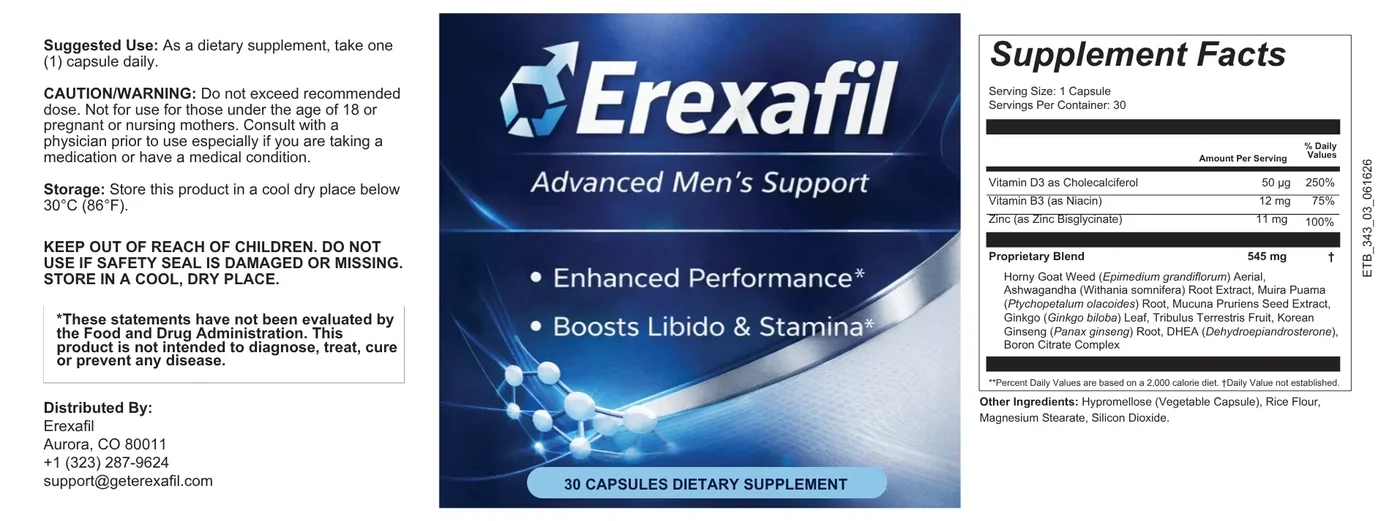
A well-built men's formula should pair researched botanicals with disclosed amounts of the minerals that actually matter — zinc, magnesium, boron and vitamin D3 — so you can check the panel against the ranges in this article. Erexafil lists its full label on the official store.
Check Availability & PricingBoron: the SHBG lever and free testosterone
Boron is the least famous of the three and, gram for gram, one of the more interesting. Its headline effect is not on how much testosterone you produce but on how much of it stays available. In small human studies, supplementing roughly 6 to 10 mg of boron per day for about a week was associated with a drop in sex hormone-binding globulin, the transport protein that keeps a large share of your testosterone locked up and biologically inactive. Lower SHBG means more of the testosterone you already make is left unbound — the free fraction that your tissues can actually use. So boron can raise free testosterone even when total testosterone barely moves, because it is redistributing what is already there rather than manufacturing more.
Two honest caveats keep this in proportion. First, the studies are small and short, so boron belongs in the "promising supporting mineral" category, not the "proven centrepiece" one. Second, because the mechanism is a shift in binding rather than a production boost, the practical effect is a nudge, not a transformation. That said, boron is inexpensive, needed only in tiny amounts, and safe within sensible limits, which is why a low dose is a reasonable inclusion in a men's blend even on modest evidence. It is a good example of a mineral that supports the formula without pretending to carry it.
The honest fourth: vitamin D, the hormone in disguise
No serious discussion of mineral-style support is complete without vitamin D, which behaves more like a hormone than a vitamin. Deficiency is genuinely common — a consequence of indoor lifestyles, sunscreen, latitude and darker skin tones — and correcting a real deficiency supports normal endocrine function, including the hormonal machinery relevant to men. As with zinc and magnesium, the pattern is correction rather than boost: men who are deficient tend to benefit from getting back into range, while men who are already sufficient gain little hormonally from piling on more. The cleanest move is to know your level rather than guess, then supplement to a target instead of megadosing blindly.
Zinc, magnesium and boron at a glance
The table condenses the deep-dive into the facts a buyer can act on. Read it the way you would read any label decision: not "which sounds strongest," but "what has been measured, at what dose, and who actually benefits."
| Mineral | What the evidence shows | Studied / typical dose | Who benefits most |
|---|---|---|---|
| Zinc | Required for production; deficiency lowers T, repletion restores it | 15–30 mg/day; upper limit 40 mg | Deficient men: heavy trainers, older men, plant-based diets |
| Magnesium | Raised free and total T; larger gains in men who exercise | ~200–400 mg/day elemental | Active men, poor sleepers, low dietary intake |
| Boron | Lowered SHBG, raising the free testosterone fraction | ~6–10 mg/day | Men with high SHBG and low free T |
| Vitamin D3 | Correcting deficiency supports normal hormone function | To a tested blood target | The many men who are genuinely low |
Correction of deficiency, not megadosing — and the copper trap
If there is one idea to carry out of this article, it is that these minerals reward sufficiency and punish excess. The testosterone gains in the research came from bringing low men back to normal, which means the dose-response curve is not a straight line pointing up. Once your tank is full, more does nothing for your hormones — and in zinc's case, more actively causes harm. Sustained high-dose zinc competes with copper for absorption and can drive a copper deficiency, which brings its own problems for blood, nerves and immunity. This is the single most common self-inflicted mistake in the whole category: a man reads that zinc supports testosterone, buys a 50 mg megadose, takes it for months, and quietly depletes his copper while gaining nothing hormonally because he was never deficient in the first place.
The practical takeaway is to favour sensible, food-adjacent doses inside the tolerable upper limits, and to treat any product boasting enormous single-mineral megadoses as a red flag rather than a strength. A formula that lists zinc at a reasonable amount, pairs it with a little copper, and keeps magnesium and boron in studied ranges understands this. The same disclosure-and-dose discipline is what we look for when we assess safety across the category in our guide to the real side effects of testosterone supplements and who should be careful.
Do supplements to increase testosterone work if you already eat well?
This is the objection worth answering most directly, because it is both the most common and the most fair. If the effect is correction of a deficiency, then a man with a genuinely good diet — plenty of zinc-rich protein, magnesium from greens, nuts and whole grains, adequate sun or vitamin D — should not expect his testosterone to jump from adding these minerals. And that is true. We would rather say so than pretend otherwise. But two things keep the picture honest. First, deficiency is far more widespread than most men assume, particularly for magnesium and vitamin D, so plenty of people who feel they "eat well" are still short. Second, these minerals do real work beyond hormones — sleep, muscle function, recovery, immune health — so sufficiency is worth maintaining regardless of what the number on a testosterone test does.
The mature way to think about it: minerals are the foundation, not the fireworks. They make sure the machinery has its tools. Herbs with human data — the kind we examine in our review of the evidence for Korean ginseng, ashwagandha and zinc in male vitality — sit on top of that foundation and address stress, fatigue and drive through different routes. A good men's formula, including the Erexafil formula, is really an attempt to cover both layers at once: the mineral base that fixes bottlenecks, and the researched botanicals that support the rest.
Three myths worth retiring
"If a little zinc helps, a lot will help more." This is the myth that does the most damage. The dose-response for correcting a deficiency flattens the moment you are sufficient, and pushing past 40 mg per day risks copper depletion. More zinc past the point of sufficiency buys you side effects, not testosterone.
"Boron raised my total testosterone." Almost certainly not by much. Boron's documented action is on SHBG and the free fraction, so it changes the availability of testosterone more than the total quantity. That is still useful — free testosterone is the part your body acts on — but it is a redistribution, and the studies behind it are small.
"Minerals are too basic to matter, the herbs are what count." Backwards. The minerals have the cleaner mechanism and, for zinc and magnesium, the clearer human data for the specific outcome of testosterone. The exotic herb on the front of the bottle is usually the part with the weakest evidence, not the strongest. Judge a formula by its mineral panel and disclosed amounts before you fall for the hero ingredient on the label.
Medical note: this article is general information, not medical advice, and is not a claim that any mineral or supplement diagnoses, treats, cures or prevents disease. Do not exceed the tolerable upper limits, and be aware that high-dose zinc can deplete copper. Speak to a healthcare professional before starting any supplement, especially if you take medication or manage a kidney, heart or hormone-sensitive condition.
Scientific references
- NIH Office of Dietary Supplements — Zinc Fact Sheet for Health Professionals
- NIH Office of Dietary Supplements — Magnesium Fact Sheet for Health Professionals
- Cinar et al., Biological Trace Element Research 2011 — Effects of magnesium supplementation on testosterone levels of athletes and sedentary subjects at rest and after exhaustion (PubMed)
- Naghii et al., Journal of Trace Elements in Medicine and Biology 2011 — Comparative effects of daily and weekly boron supplementation on plasma steroid hormones and proinflammatory cytokines (PubMed)
- NIH Office of Dietary Supplements — Vitamin D Fact Sheet for Health Professionals
Frequently asked
Which minerals actually help increase testosterone?
Three minerals have the strongest evidence: zinc, magnesium and boron, with vitamin D a close honourable mention because it acts hormonally. The common thread is correction of a shortfall. Zinc is required for normal testosterone production and repletion helps men who are genuinely low; magnesium raised free and total testosterone in studies, with larger gains in men who exercise; boron appears to lower sex hormone-binding globulin (SHBG) and nudge free testosterone up. These are supplements to increase testosterone by fixing a deficiency, not exotic hormone triggers, and their effect is modest and realistic rather than dramatic.
How much zinc and magnesium should men take for testosterone?
Studied intakes sit close to everyday nutritional ranges rather than megadoses. For zinc, human research and the recommended dietary allowance point to roughly 11 mg per day for adult men, with supplement doses commonly in the 15 to 30 mg range and a tolerable upper limit of 40 mg from all sources. For magnesium, trials showing a testosterone effect used around 10 mg per kilogram of body weight in active men, while typical supplemental doses land near 200 to 400 mg of elemental magnesium daily. Higher is not better: excess zinc in particular depletes copper, so more is a risk, not a bonus.
What does boron do for free testosterone?
Boron's most-cited effect is on free testosterone rather than total. In small human studies, supplementing roughly 6 to 10 mg of boron per day for about a week was associated with a drop in sex hormone-binding globulin (SHBG), the protein that keeps testosterone bound and inactive. When SHBG falls, more of the testosterone you already produce is left unbound and biologically available, which can raise the free fraction even if total testosterone barely moves. It is a redistribution effect more than a production boost, and the studies are small, so treat it as a supporting mineral rather than the star.
Do you still benefit if you are not deficient?
Mostly the benefit tracks how deficient you were to begin with. The clearest testosterone gains in the research came from correcting a genuine shortfall, so a man who is already well-supplied with zinc, magnesium and vitamin D should expect little to no hormonal lift from adding more. That is not a reason to skip them entirely, because these minerals matter for sleep, muscle function and general health, but it is a reason to be honest: topping up a full tank does not raise testosterone, and pushing past the upper limits can cause harm such as copper depletion from high-dose zinc.
Build on the mineral foundation
If you would rather cover the researched base than gamble on a hero herb, Erexafil is a once-daily men's capsule pairing zinc, magnesium-supporting nutrients and named botanicals with amounts on the panel. The official store lists the current options and the full label.
See Erexafil on the Official Store