Vitamin D3 in Erexafil: What 250% DV Actually Means
Quick Answer: What Does 250% DV Mean Here?
Erexafil's label prints 50 mcg (2,000 IU) of Vitamin D3 as cholecalciferol per capsule, listed at 250% of the Daily Value. That percentage comes from a fixed FDA reference amount, not from any individual's personal needs. 50 mcg sits below the NIH Office of Dietary Supplements' Tolerable Upper Intake Level of 100 mcg (4,000 IU) per day for adults — but that ceiling counts every D3 source added together, not each product judged on its own.
- On Erexafil's label: 50 mcg (2,000 IU) Vitamin D3 as cholecalciferol, 250% DV.
- FDA reference Daily Value used for that percentage: 20 mcg (800 IU).
- NIH adult Tolerable Upper Intake Level: 100 mcg (4,000 IU) per day, from all sources combined.
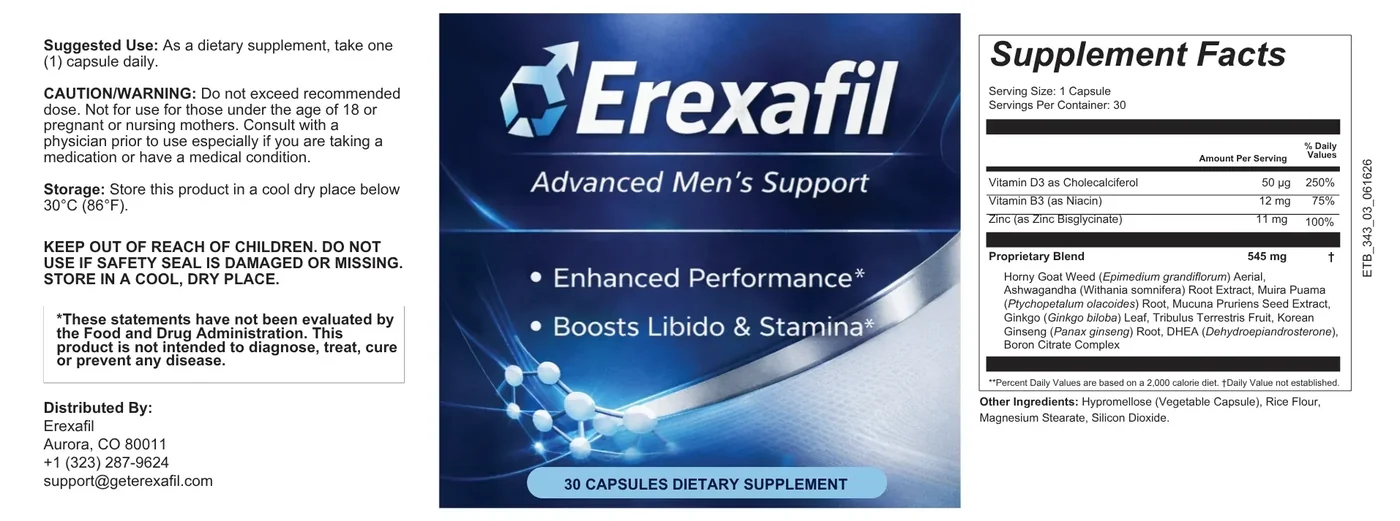
Vitamin D3 is one of only three individually dosed nutrients on Erexafil's label — alongside Vitamin B3 (Niacin) and Zinc — printed with an exact milligram or microgram amount and a calculated percent Daily Value, unlike the nine botanicals that share one undivided 545 mg proprietary blend. That makes it one of the few ingredients in this formula where the dosing math can actually be checked against a public reference standard. This article does exactly that: it walks through what "250% DV" is actually measuring, places the 50 mcg dose against the federal upper safety limit for adults, and explains the one practical habit — adding up every Vitamin D3 source you take, not reading each product's percentage in isolation — that the %DV number on any single label cannot do for you.
What Erexafil's label discloses about Vitamin D3, exactly
The Supplement Facts panel lists "Vitamin D3 as Cholecalciferol" at 50 mcg (micrograms) per one-capsule serving, with "250%" printed in the adjacent %DV column. Cholecalciferol is the same form of vitamin D the human body produces in skin exposed to UVB sunlight, and it is the form most commonly used in over-the-counter supplements, as distinct from D2 (ergocalciferol), which is typically plant- or fungus-derived. The label states no additional detail beyond the amount, the form and the percentage — there is no claim about absorption enhancement, timed release or any special delivery technology for this ingredient.
Vitamin D3 in Erexafil, at a glance
| Point | What is actually printed or published |
|---|---|
| Amount per capsule | 50 mcg (equal to 2,000 IU) Vitamin D3 as cholecalciferol |
| Percent Daily Value shown on label | 250% |
| FDA reference Daily Value for vitamin D (supplement labels) | 20 mcg (800 IU) |
| NIH adult Tolerable Upper Intake Level (UL) | 100 mcg (4,000 IU) per day, all sources combined |
| 50 mcg as a share of the adult UL | Exactly half (50%) of the 100 mcg ceiling |
See the full formula behind the label
Vitamin D3 is one of three individually dosed nutrients in Erexafil, alongside Vitamin B3 and Zinc, plus nine botanicals inside one proprietary blend. See the full label and current pricing.
Order ErexafilThe arithmetic behind "%DV," explained once and for all
A Daily Value, as used on U.S. Nutrition and Supplement Facts panels, is not a personalized target and it is not a recommendation specific to your age, sex, weight or health status. It is a single fixed reference amount that the FDA sets for labeling purposes, applied the same way to every adult and child over age four regardless of individual need. For vitamin D, the FDA's 2016 update to the Nutrition and Supplement Facts label regulations set that reference amount at 20 mcg (800 IU) per day, up from the older 1968-era value of 10 mcg (400 IU).[1] The percentage printed next to any nutrient is simply that product's amount divided by the reference amount, multiplied by 100.
Applied to Erexafil: 50 mcg divided by the 20 mcg reference amount equals 2.5, and 2.5 expressed as a percentage is 250% — exactly the figure printed on the label. There is no additional science or brand-specific claim embedded in that percentage; it is pure division against a fixed federal reference point, and any supplement containing 50 mcg of vitamin D3 from any brand would print the identical 250% figure. Understanding this turns "250% DV" from an intimidating-sounding number into what it actually is: a statement that this capsule provides two and a half times the fixed reference amount the FDA uses for label percentages, nothing more and nothing less.
Where 50 mcg sits against the Tolerable Upper Intake Level
A Daily Value is a labeling reference, not a safety ceiling. The safety ceiling is a separate, independently derived figure called the Tolerable Upper Intake Level (UL), published by the National Academies of Sciences, Engineering, and Medicine and summarized by the NIH Office of Dietary Supplements. For vitamin D, the UL for adults and for pregnant or breastfeeding women aged 19 and older is 100 mcg (4,000 IU) per day, representing the highest daily intake from all sources — food, beverages and supplements combined — that is unlikely to cause adverse health effects in the general population.[2]
Erexafil's one-capsule 50 mcg dose is below that ceiling: it represents exactly half of the adult UL, with 50 mcg of headroom remaining before the 100 mcg threshold is reached, assuming zero other sources of vitamin D that day. Being under the UL when this one product is considered in isolation is a genuinely meaningful fact, and it means a single capsule of Erexafil, taken as the only source of supplemental vitamin D3 on a given day, sits within the range NIH treats as unlikely to cause adverse effects for a healthy adult with no absorption or metabolic issue affecting vitamin D handling. That is a real and useful data point. It is also, on its own, an incomplete answer to "is this safe for me," for the reason covered next.
The part a single label's %DV cannot tell you: stacking
The Tolerable Upper Intake Level is explicitly defined as a ceiling on total intake from every source combined, not a per-product allowance that resets with each new bottle.[2] This single design fact is the entire reason the stacking question matters, and it is also the reason no single product's printed %DV, taken alone, can answer whether a given amount is appropriate for a specific person on a specific day. A man's total daily vitamin D3 intake is the sum of every source he is exposed to, and several common, everyday sources are easy to overlook if you are only reading one label at a time:
- A separate, standalone Vitamin D3 supplement. Many are sold in doses from 25 mcg (1,000 IU) up to 125 mcg (5,000 IU) or higher per capsule — a 50 mcg standalone D3 tablet taken alongside Erexafil's 50 mcg would already total 100 mcg, the full adult UL, from these two products alone.
- A daily multivitamin. Most multivitamins include some vitamin D3, commonly in the 10–25 mcg (400–1,000 IU) range, which adds directly on top of any other source.
- Fortified foods and beverages. Fortified milk, some plant-based milk alternatives, certain breakfast cereals and some orange juice products are fortified with vitamin D, typically in smaller per-serving amounts, but they still count toward the same daily total.
- Heavy sun exposure. The skin synthesizes vitamin D3 on UVB exposure, and the amount produced varies enormously by skin tone, latitude, season, time of day and how much skin is exposed — it is real, but it is also the least precisely quantifiable source on this list.
- A prescription high-dose vitamin D product. Clinicians sometimes prescribe very high weekly or monthly doses (commonly 50,000 IU/1,250 mcg weekly for a defined correction period) to correct a diagnosed deficiency; a man on such a regimen who is unaware it overlaps with an OTC supplement's D3 content has a materially different math problem than someone with no other source.
None of this means 50 mcg is dangerous by itself, and it does not mean every man taking Erexafil needs to worry. It means the 250% figure on Erexafil's own panel was never designed to answer the stacking question, because no single product's label can see what else is in your medicine cabinet, your multivitamin or your diet that week. The only way to answer "is my total vitamin D3 intake appropriate" is to add up the printed amount from every source you actually take, the same arithmetic used above for the DV calculation, just applied across products instead of within one.
When a blood test is worth asking for
The most direct way to know where you actually stand, rather than estimating from labels alone, is a serum 25-hydroxyvitamin D [25(OH)D] blood test, the standard clinical measure of vitamin D status.[2] Asking a clinician about this test is a reasonable step before combining multiple D3-containing products, particularly in a few specific situations: if you already take a separate, dedicated vitamin D3 supplement in addition to a multivitamin or a product like Erexafil; if you have a condition affecting calcium or vitamin D metabolism, such as a kidney or parathyroid disorder, granulomatous disease, or a history of hypercalcemia; if you take medications that interact with vitamin D metabolism (certain diuretics and some others, per a clinician's own review of your regimen); or simply if you want a concrete number instead of adding up label percentages by hand. A blood test turns "I think I might be stacking too much" into an actual, individualized figure a clinician can act on, which no supplement label, including this one, is designed to provide on its own.
Three questions worth asking before you buy
“Is 250% DV an unusually high or aggressive dose?” Not by itself. It is two and a half times a fixed FDA reference amount that was set for general labeling purposes, and the resulting 50 mcg figure sits at half of the NIH's adult upper intake ceiling when considered as a single, standalone source.
“Does being under the UL mean it's automatically fine to combine with my multivitamin?” Not automatically — it means this one product alone is under the ceiling. Whether combining it with another D3 source stays under that same ceiling depends entirely on what that other product's label prints, which this article cannot see for you.
“Do I need to worry about Vitamin D3 toxicity from one capsule a day?” At 50 mcg as a single daily source, that dose is within the range the NIH treats as generally safe for healthy adults. Vitamin D toxicity (hypervitaminosis D) is a real but uncommonly reported condition typically associated with intakes far above the UL sustained over time, most often from high-dose supplement errors rather than food or moderate sun exposure; it is not a reason to avoid an on-label dose, but it is a reason to actually do the stacking arithmetic above rather than skip it.
How Erexafil handles Vitamin D3, honestly
Erexafil's label discloses the Vitamin D3 amount, form and percent Daily Value clearly and without ambiguity — this is one of the more transparent lines on the entire panel, especially compared with the nine botanicals sharing one undivided proprietary-blend total. What the label cannot do, because no single product's label is designed to, is account for every other vitamin D3 source already present in a given man's daily routine. That arithmetic belongs to the person taking the product, using the amounts printed on each item they actually use, and a 25(OH)D blood test where the picture is unclear. For the rest of the formula and the full ingredient-by-ingredient picture, see our Erexafil review of ingredients and cost.
Medical note: this article is general information, not medical advice. It does not know what other vitamin D3 sources you take. Add up the printed amounts from every product you use, and speak with a healthcare professional, including about a 25(OH)D blood test, before combining multiple vitamin D3 sources or if you have a condition affecting calcium or vitamin D metabolism.
Scientific references
- U.S. FDA — Daily Value on the Nutrition and Supplement Facts Labels (2016 update, vitamin D reference amount)
- NIH Office of Dietary Supplements — Vitamin D, Health Professional Fact Sheet (Tolerable Upper Intake Level, 25(OH)D testing)
- NIH Office of Dietary Supplements — Vitamin D, Consumer Fact Sheet
- U.S. FDA — dietary supplement labeling overview
Related reading
Frequently asked
How much Vitamin D3 is in Erexafil?
50 mcg (equal to 2,000 IU) of Vitamin D3 as cholecalciferol, printed at 250% of the Daily Value on the Supplement Facts panel.
How is the 250% Daily Value figure calculated?
The FDA's Daily Value for vitamin D on supplement labels is 20 mcg (800 IU). Dividing Erexafil's 50 mcg by the 20 mcg reference amount gives 2.5, which is displayed as 250%.
Is 50 mcg of Vitamin D3 safe?
50 mcg is below the NIH Office of Dietary Supplements' Tolerable Upper Intake Level of 100 mcg (4,000 IU) per day for adults, which already includes a safety margin. It is not automatically safe for everyone, because the UL counts total intake from every source combined, not from one product alone.
Can I take Erexafil with a separate Vitamin D supplement?
Only after adding up every source. Erexafil's 50 mcg, a separate D3 supplement, a multivitamin's D3 content, fortified foods and sun exposure all count toward the same 100 mcg daily ceiling. Add the printed amounts from every product's own label before deciding whether to combine them, and ask a clinician about a 25(OH)D blood test if the combined total is unclear.
See the full Erexafil label and current pricing
Compare the full ingredient list, the individually dosed nutrients, and the guarantee on the official store.
Order Erexafil