Niacin (Vitamin B3) in Erexafil: The Flush Threshold, Explained
Quick Answer: Will Erexafil's Niacin Cause a Flush?
Erexafil's label lists 12 mg of Vitamin B3 as Niacin, at 75% of the Daily Value. The well-known "niacin flush" — a temporary warm, red, tingling reaction on the skin — is a dose-dependent effect of the nicotinic acid form of B3, and the NIH Office of Dietary Supplements notes it typically begins at roughly 30 to 50 mg or more taken at once in immediate-release form. Erexafil's 12 mg sits below that commonly cited starting range, meaning most people would not expect to notice it from this dose alone.
- On Erexafil's label: 12 mg Vitamin B3 as Niacin, 75% DV.
- Typical flush onset (NIH ODS): roughly 30–50 mg or more of immediate-release nicotinic acid.
- Form declared: Niacin (nicotinic acid) — the flush-associated form, not Niacinamide.
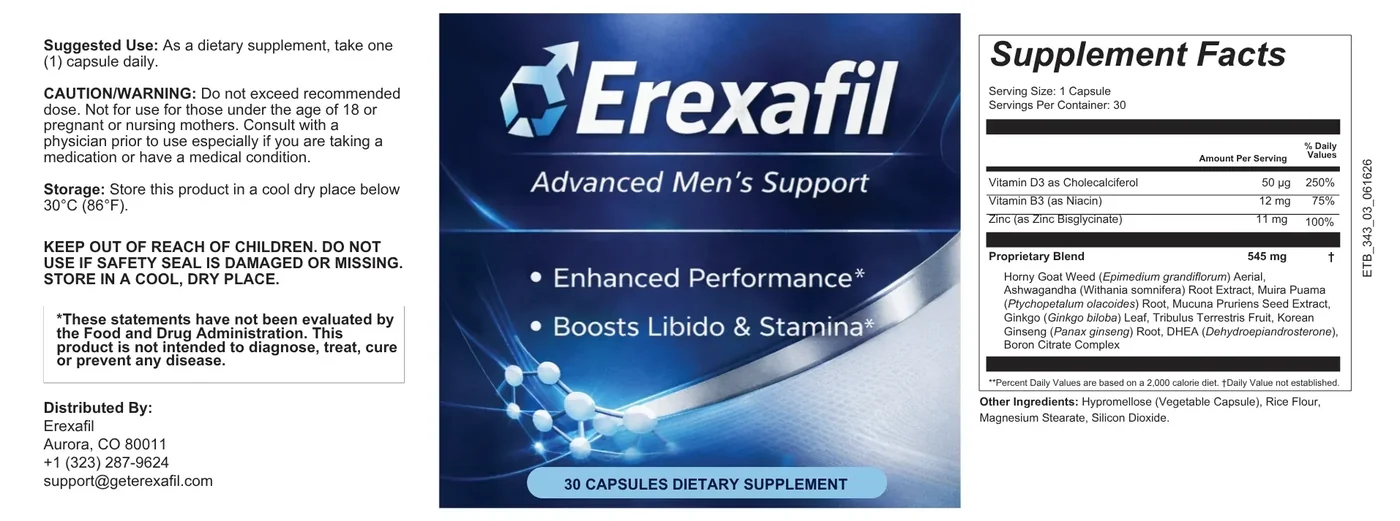
Niacin (Vitamin B3) is one of only three individually dosed nutrients on Erexafil's label, alongside Vitamin D3 and Zinc, printed with an exact milligram amount and percent Daily Value rather than buried inside the nine-botanical proprietary blend. Despite that clear disclosure, no existing article on this site treats Niacin as its own subject — it appears only as a passing name in the full ingredient list. This piece corrects that: it covers what niacin actually does at the cellular level, explains the flush reaction by name and by mechanism, does the specific arithmetic showing where Erexafil's 12 mg sits relative to the dose range that typically triggers it, and explains why "Niacin" and "Niacinamide" are two different things on a label, not two names for the same ingredient.
What niacin actually does in the body
Niacin is not primarily a "performance" ingredient in the way a botanical stimulant might be marketed; its core biological role is as a precursor for two coenzymes, NAD+ (nicotinamide adenine dinucleotide) and NADP+ (its phosphorylated form), which are required cofactors in hundreds of redox reactions throughout cellular metabolism, including the pathways that convert food into usable cellular energy.[1] Every cell in the body needs a functioning NAD+/NADP+ pool to carry out basic energy metabolism, which is why niacin is classified as an essential vitamin rather than an optional ergogenic add-in, and why a genuine dietary deficiency (historically known as pellagra) is a serious, well-characterized medical condition. At the modest 12 mg dose printed on Erexafil's label, niacin's role here is best understood as supporting normal cellular energy metabolism rather than delivering any dose-dependent pharmacological effect — the doses studied for niacin's more aggressive, flush-associated pharmacological uses (described below) run many multiples higher than 12 mg.
Niacin in Erexafil, at a glance
| Point | What is actually printed or published |
|---|---|
| Amount per capsule | 12 mg Vitamin B3 as Niacin |
| Percent Daily Value shown on label | 75% |
| FDA reference Daily Value for niacin (supplement labels) | 16 mg NE |
| Form declared | Niacin (nicotinic acid) — not Niacinamide (nicotinamide) |
| Typical immediate-release flush onset (NIH ODS) | Roughly 30–50 mg or more, taken at once |
| Adult Tolerable Upper Intake Level for supplemental niacin (NIH ODS) | 35 mg per day, based on flushing as the defining adverse effect |
See the full formula behind the label
Niacin is one of three individually dosed nutrients in Erexafil, alongside Vitamin D3 and Zinc, plus nine botanicals inside one proprietary blend. See the full label and current pricing.
Order ErexafilThe niacin flush, explained mechanistically
The "niacin flush" is one of the best-documented side effects in all of vitamin pharmacology, because niacin at pharmacological doses has a decades-long history of clinical use for managing cholesterol, which put the flush reaction under close scientific study.[1] The mechanism is now well characterized: nicotinic acid (the niacin form, not niacinamide) binds a cell-surface receptor called HCA2, also known as GPR109A, found on Langerhans cells in the skin.[2] Activating that receptor triggers the release of vasodilating prostaglandins, principally PGD2 and PGE2, which widen small subcutaneous blood vessels. The visible result is a reddening of the face, arms and chest, usually accompanied by a warm, tingling or itching sensation, typically appearing within 30 minutes to two hours of a sufficiently large dose and fading within roughly 30 to 60 minutes as the prostaglandin response subsides. It is, by every available clinical description, an uncomfortable but non-dangerous and self-limited reaction — a vasodilatory nuisance, not a toxic one.
Because the mechanism runs through a specific, saturable receptor-and-prostaglandin pathway rather than a simple linear dose-response, the flush is also a genuinely dose-dependent phenomenon: small doses may produce no noticeable effect, moderate immediate-release doses produce the classic flush in many people, and formulation matters as much as raw dose. Extended-release or "no-flush" formulations are specifically engineered to slow nicotinic acid absorption and blunt the peak concentration that triggers the receptor response, which is why the same total daily milligram amount can feel completely different depending on how it is released into the bloodstream.[1]
The arithmetic: where 12 mg sits against the flush threshold
The NIH Office of Dietary Supplements' health professional fact sheet on niacin states that flushing typically appears at roughly 30 to 50 mg or more of immediate-release nicotinic acid, and separately lists a Tolerable Upper Intake Level of 35 mg per day for supplemental niacin in adults, a figure explicitly derived using flushing itself as the critical adverse effect used to set the ceiling.[3] Erexafil's label prints 12 mg of Niacin per capsule. Twelve is roughly a third of the low end of that commonly cited 30–50 mg onset range, and it is also below the 35 mg UL. Put plainly: at the printed one-capsule dose, Erexafil's Niacin content sits comfortably under both the range most commonly associated with a noticeable flush and the federal upper intake ceiling set specifically to keep flushing risk low. This does not mean flushing is impossible for every person at every dose — individual sensitivity varies, and some especially sensitive individuals report a mild effect at lower doses — but it does mean the dose printed on this label is not in the range the clinical and regulatory literature associates with flushing as an expected, common event.
Why "Niacin" and "Niacinamide" are declared differently, and why that matters
This is the single most useful label-reading skill this ingredient teaches, and it generalizes well beyond Erexafil. Niacin (nicotinic acid) and Niacinamide (nicotinamide) are both legitimate, FDA-recognized forms of Vitamin B3 that can satisfy the same nutritional requirement for NAD+/NADP+ synthesis, but they are chemically distinct compounds with a meaningfully different side-effect profile. Niacinamide does not bind the HCA2/GPR109A skin receptor the same way nicotinic acid does, and as a direct result it does not produce the flushing reaction, even at considerably higher milligram intakes than would reliably flush someone on the nicotinic acid form.[3] This is precisely why the two are printed as separate, distinctly named ingredients on a Supplement Facts panel rather than being interchangeable line items: the form, not just the milligram number, determines what a person taking the capsule should actually expect to feel.
Applied practically, this means a shopper comparing two men's-health supplements cannot assume they will have the same experience just because both print "Vitamin B3" at a similar milligram amount — the line has to specify which form, because that single word ("Niacin" versus "Niacinamide") is the difference between a product capable of producing a flush at a high enough dose and one that structurally is not. Erexafil's label is specific on this point: it names the form as Niacin, not Niacinamide, so the flush-threshold arithmetic above is the relevant comparison for this particular product.
Why formulation (immediate-release vs. extended-release) also matters
The flush threshold figures cited above apply specifically to immediate-release nicotinic acid, which is the form most consumer capsules, including standard multivitamins and single-ingredient niacin supplements, use unless the label specifically states otherwise.[1] Extended-release and sustained-release niacin formulations, more commonly seen in prescription-strength cholesterol-management products, are designed to release the same total milligram amount more slowly, which blunts the peak blood concentration responsible for triggering the flush receptor — at the cost, in some of those products, of a different and separately documented liver-related caution profile at the much higher doses used for lipid management, which is a different discussion entirely from the modest nutritional dose on this label. Nothing on Erexafil's Supplement Facts panel indicates an extended-release or modified-delivery formulation for its Niacin; it should be read as a standard immediate-release ingredient at 12 mg.
Three questions worth asking before you buy
“Will I flush after taking Erexafil?” Based on the published flush-onset range for immediate-release nicotinic acid, 12 mg is below the dose most commonly associated with a noticeable reaction. Individual sensitivity varies, so it is not an absolute guarantee for every person, but it is not the dose range clinical sources associate with common flushing.
“If I do notice warmth or redness, is that dangerous?” Where it occurs, the niacin flush is well documented as an uncomfortable but transient and non-toxic prostaglandin-mediated skin reaction, not a sign of organ toxicity. That said, any new or unexpected symptom after starting a supplement is worth mentioning to a healthcare professional, particularly if it is severe, persistent, or accompanied by other symptoms.
“Why include Niacin at only 12 mg instead of a higher, more 'noticeable' dose?” At 12 mg, Niacin is functioning as a standard nutritional-support ingredient contributing to normal cellular energy metabolism via the NAD+/NADP+ pathway, not as a pharmacological-dose cholesterol-management ingredient, which is an entirely different, much higher-dose use case studied and regulated separately.
How Erexafil handles Niacin, honestly
Erexafil's label discloses the Niacin amount, form and percent Daily Value clearly, which lets this specific dose-versus-flush-threshold comparison be made with confidence — unlike the nine botanicals sharing one undivided proprietary-blend total elsewhere on the same panel. The label does not print any specific claim about the flush, energy or otherwise for this ingredient beyond the standard amount and %DV, and this article's flush-threshold framing is drawn from NIH and pharmacology literature, not from anything Erexafil's own marketing states. For the rest of the formula and the full ingredient-by-ingredient picture, see our Erexafil review of ingredients and cost.
Medical note: this article is general information, not medical advice. Individual sensitivity to niacin varies. Speak with a healthcare professional before starting any supplement, particularly if you take a separately prescribed niacin product, a statin or another cholesterol medication, or have a liver condition.
Scientific references
- Cooper et al., Int J Pharm 2015 — Effects of formulation design on niacin therapeutics: mechanism of action, metabolism, and drug delivery (PubMed)
- Hanson, Gille & Offermanns, Pharmacol Ther 2012 — Role of HCA2 (GPR109A) in nicotinic acid and fumaric acid ester-induced effects on the skin (PubMed)
- NIH Office of Dietary Supplements — Niacin, Health Professional Fact Sheet (flush onset dose, Tolerable Upper Intake Level, Niacin vs. Niacinamide)
- U.S. FDA — Daily Value on the Nutrition and Supplement Facts Labels (2016 update, niacin reference amount)
- U.S. FDA — dietary supplement labeling overview
Related reading
Frequently asked
How much Niacin is in Erexafil?
12 mg of Vitamin B3 as Niacin, printed at 75% of the Daily Value on the Supplement Facts panel.
What is the niacin flush?
A temporary reddening, warmth, tingling or itching of the skin, most often on the face, arms and chest, caused by immediate-release nicotinic acid binding a skin receptor (HCA2/GPR109A) and triggering prostaglandin-mediated vasodilation. It is uncomfortable but is considered a harmless, transient side effect, not a sign of toxicity.
At what dose does niacin flush typically start?
The NIH Office of Dietary Supplements notes that flushing typically begins at roughly 30 to 50 mg or more of immediate-release nicotinic acid taken at once. Erexafil's 12 mg dose sits below that commonly cited starting range.
Why do some labels say "Niacin" and others say "Niacinamide"?
They are different chemical forms of vitamin B3. Niacin (nicotinic acid) is the form associated with flushing at higher doses. Niacinamide (nicotinamide) is chemically different, does not activate the same skin receptor, and does not cause the flushing reaction, even at considerably higher intakes. Reading which form is printed tells you what to expect before taking a capsule.
See the full Erexafil label and current pricing
Compare the full ingredient list, the individually dosed nutrients, and the guarantee on the official store.
Order Erexafil