Muira Puama in Erexafil: Traditional Use vs. What Trials Actually Tested
Quick Answer: What Does Muira Puama Actually Have Behind It?
Muira Puama (Ptychopetalum olacoides) has a genuine traditional-use history in the Brazilian Amazon as a "potency wood" for low libido and fatigue, but the modern research trail is thin. A PubMed search found no controlled human trial of Muira Puama taken alone at a defined dose. The closest human data is a small open (non-blinded) trial that combined it with ginkgo biloba in women, not men. Erexafil's label prints no individual amount for it; it sits inside an undivided 545 mg proprietary blend with eight other ingredients.
- Traditional use: well documented in Brazil, but that is not the same evidence tier as a clinical trial.
- Human trial evidence for Muira Puama alone: none found at a stated, isolated dose.
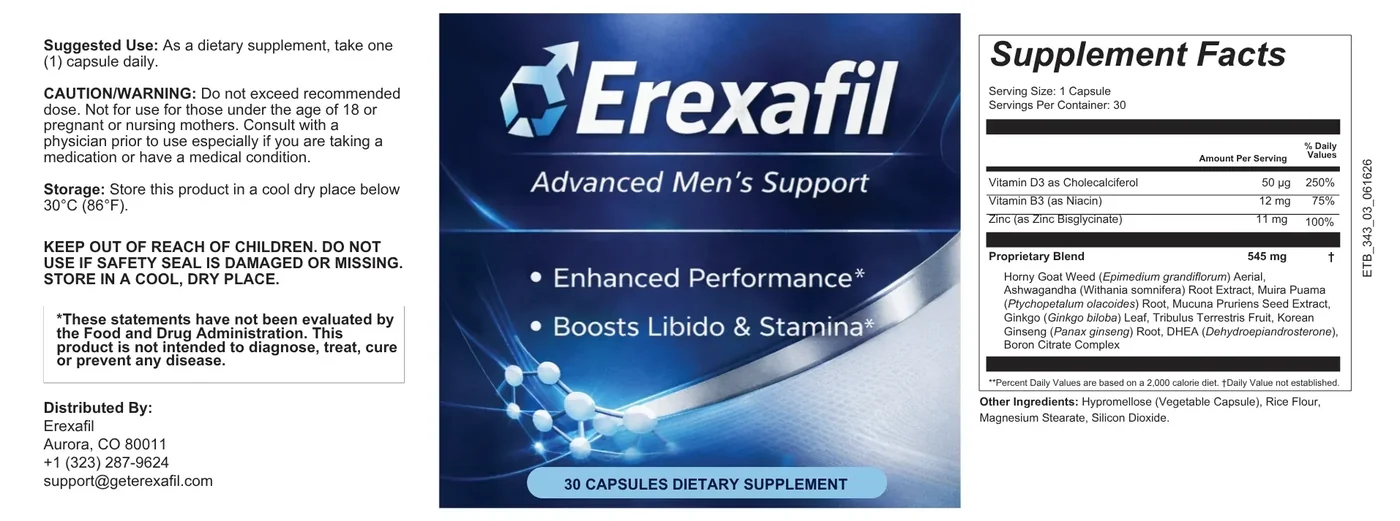
- On Erexafil's label: inside the 545 mg proprietary blend, no individual amount disclosed.
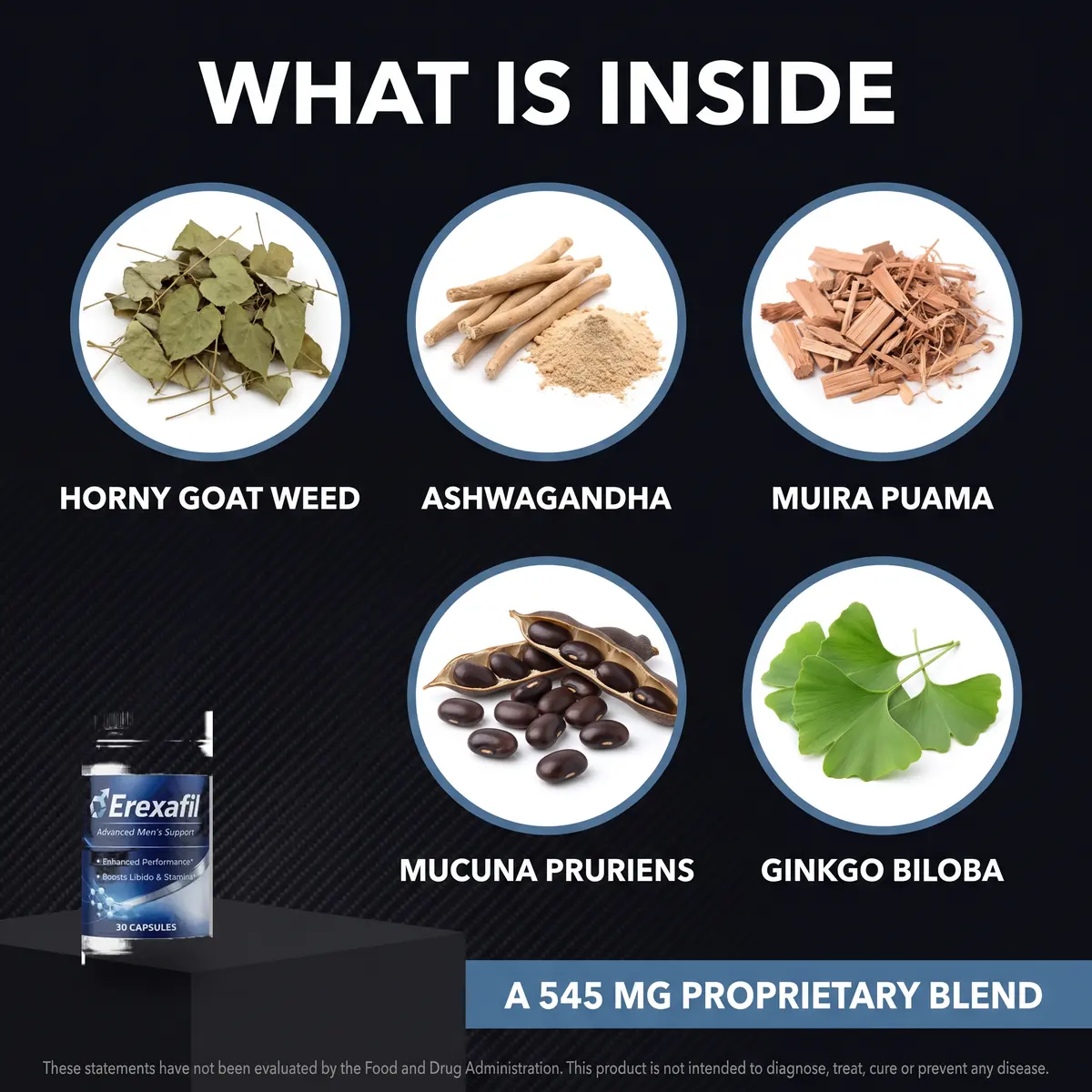
Muira Puama shows up in a lot of men's vitality formulas, Erexafil included, riding on a genuinely old reputation. The trouble is that "genuinely old" and "clinically proven" are two very different claims, and the marketing copy around this ingredient tends to blur them together. This article separates the two: what the traditional record actually says, what the handful of real controlled studies actually tested (and on whom), and exactly what Erexafil's own label does and does not disclose about how much of it you are getting. Nothing here is invented — every dose, study detail and label fact below is either printed on Erexafil's Supplement Facts panel or drawn from a PubMed-indexed study, cited at the bottom of the page.
What Muira Puama is, and where its reputation comes from
Muira Puama (Ptychopetalum olacoides) is a small tree native to the Brazilian Amazon basin. Its root and bark have a long history of use in Brazilian folk medicine, where it has earned nicknames along the lines of "potency wood," alongside traditional use for fatigue, nervous exhaustion and general low vitality. Ethnobotanical surveys of Brazilian medicinal plants document this traditional reputation in some detail, and it is genuine — this is not an invented marketing story. A 2007 ethnopharmacological survey of Brazilian plants used as adaptogens specifically catalogued Ptychopetalum olacoides among the botanicals with this kind of traditional standing.[3]
What traditional use does not do, however, is tell you a safe or effective dose, or confirm an effect in a controlled setting where a placebo group rules out expectation and natural fluctuation. Plenty of substances with centuries of traditional use turn out, when finally tested rigorously, to do less than folklore suggested — and some turn out to do more. The only way to know which category an ingredient falls into is to look at what has actually been tested, on whom, and how carefully.
What Erexafil's label says about Muira Puama, exactly
Here is the fact that most marketing pages skip over: Erexafil's printed Supplement Facts panel lists Muira Puama (Ptychopetalum olacoides) Root as the third of nine ingredients inside a single 545 mg "Proprietary Blend." The panel's footnote marks this blend with a dagger for "Daily Value not established," and prints one combined weight for all nine botanicals together — Horny Goat Weed, Ashwagandha, Muira Puama, Mucuna Pruriens, Ginkgo Biloba, Tribulus Terrestris, Korean Ginseng, DHEA and Boron Citrate Complex. No individual milligram amount is printed for Muira Puama, and none is printed for any of the other eight ingredients that share that 545 mg. This is standard practice for a "proprietary blend," and it is legal, but it means a reader genuinely cannot know from the label alone whether the Muira Puama dose is a meaningful fraction of a gram or a token amount added mostly for the ingredient list.
Muira Puama in Erexafil, at a glance
| Point | What is actually known |
|---|---|
| Where it sits on the label | Inside the 545 mg proprietary blend, listed 3rd of 9 ingredients |
| Individual amount printed | None — only the combined 545 mg blend total is disclosed |
| Extract standardization | Not printed (no ratio or marker compound stated) |
| Controlled human trial of Muira Puama alone | None found on PubMed at a stated, isolated dose |
| Closest human trial | Small, open-label, combined with ginkgo biloba, in women (not men) |
| Animal/mechanistic evidence | Mouse anti-stress study; included in a 2020 human sexual-enhancer safety review |
See the full formula behind the marketing
Erexafil is a once-daily capsule that lists Muira Puama alongside eight other botanicals inside one proprietary blend, plus three individually dosed nutrients (Vitamin D3, Vitamin B3 and Zinc) printed with exact amounts. See the full label and current pricing.
Order ErexafilWhat the controlled studies actually tested
This is the part worth reading slowly, because it is where the traditional reputation and the clinical record genuinely part ways. A broad PubMed search for Ptychopetalum olacoides combined with sexual, libido or erectile terms returns only a small handful of results, and none of them is a placebo-controlled human trial of Muira Puama used by itself at a clearly stated dose in men.
The most-cited human study involving Muira Puama is a trial published in 2000 in the journal Advances in Therapy by Waynberg and Brewer, which tested a combination herbal formulation ("Herbal vX") containing Muira Puama and ginkgo biloba together, in 202 healthy women who reported low sex drive.[1] Participants rated their own sexual function before and after one month of taking the combination, and the researchers reported statistically significant improvements from baseline in several self-reported measures. Two details matter enormously here and are easy to miss in a quick summary: first, this trial was conducted in women, not men, so it says nothing directly about how Erexafil's mostly-male target audience would respond; second, it used a before-and-after, open-label design without a placebo control group — the paper's own text notes that "a double-blind study is planned" as a next step, which tells you the authors themselves treated this as preliminary. An uncontrolled, self-rated trial in a different population, of a two-ingredient combination rather than Muira Puama alone, is real published research, but it is a long way from proof that an unstated milligram amount of Muira Puama inside a nine-ingredient blend will do anything measurable for a man taking Erexafil.
Separately, a controlled laboratory study published in Phytomedicine in 2010 examined Ptychopetalum olacoides extract ("Marapuama") in mice and reported anti-stress effects on standardized behavioral stress tests.[2] This is legitimate mechanistic evidence that the plant has biological activity worth studying further, and it is consistent with the traditional "nervous exhaustion" use case. But a mouse behavioral study, however well controlled within its own design, cannot establish a human dose, and it says nothing about libido or erectile function specifically — it is evidence about stress response in animals, not a performance claim in men.
Finally, Muira Puama (Ptychopetalum olacoides) was included among fourteen herbal sexual enhancers surveyed in a 2020 pharmacology review published in Pharmaceuticals, which searched PubMed, Scopus and Web of Science through mid-2020 specifically for psychiatric and neurological adverse effects across this category of ingredients.[4] The review's overall conclusion for the ingredients it covered, including Muira Puama, was that most appeared safe at therapeutic doses with mild-to-severe effects mainly reported in cases of overdosing or self-medication with unstandardized products — but the same review explicitly flagged that data on several of these plants, including this one, remained limited, and called for more controlled clinical studies with monitored administration. In plain terms: even a review built specifically to catalogue problems did not find much of a red flag for Muira Puama, but it also did not find much of an evidence base to draw firm conclusions from either way.
Why the missing dose is the whole story
None of this means Muira Puama is a bad ingredient to include. It means that whatever effect a well-dosed amount of Muira Puama might eventually be shown to have in men, you cannot currently verify from Erexafil's label whether you are getting a dose anywhere near a level that has been studied at all — because no isolated human dose-response study of Muira Puama in men exists to compare against in the first place. This is a genuinely unusual situation compared with better-studied ingredients: it is not that Erexafil under-doses a well-established effective amount, it is that science has not yet established what an effective amount would even look like. A proprietary blend hides the exact share either way, but here it is compounding a second, separate gap in the underlying research.
This is also why a "how it works" list on a sales page — the kind that groups Muira Puama under "performance and libido" alongside Horny Goat Weed and Tribulus — is a marketing grouping, not a citation. It may be directionally consistent with the traditional-use literature, but it is not the same thing as a trial showing that grouping produces a measurable outcome in men taking this specific formula. Readers who want to evaluate the claim honestly need to hold those two things separate: a reasonable traditional rationale for inclusion, and the absence, so far, of the human trial data that would confirm it works at whatever dose is actually in the capsule.
Safety considerations worth knowing
Within the limited data available, Muira Puama does not stand out as a high-risk ingredient. The 2020 pharmaceutical safety review that specifically searched for psychiatric and neurological adverse effects across herbal sexual enhancers did not flag Muira Puama as a major concern, though it also noted that data across this ingredient class generally remained thin and that drug interactions are a bigger concern than standalone toxicity, particularly when herbal ingredients are combined with other plant extracts or pharmaceuticals — exactly the situation inside a nine-ingredient proprietary blend like Erexafil's.[4] Because no standardized human dose has been established, and because Muira Puama is combined here with several other biologically active ingredients (including DHEA, a hormone precursor, and Mucuna Pruriens, a natural source of L-dopa), anyone taking prescription medication, managing a health condition, or who is pregnant, nursing or under 18 should not treat traditional use as a green light and should speak with a healthcare professional before starting, consistent with the caution printed directly on Erexafil's own label.
Three questions worth asking before you buy
“If it's traditional, isn't it basically proven by centuries of use?” Traditional use is evidence of a plausible rationale and a long safety record within traditional dosing practices, not evidence of a specific measurable effect at a specific modern dose. The two are related but not interchangeable, and honest reporting keeps them separate.
“Does the fact that it's in a combination trial with ginkgo mean it works?” It means a two-ingredient combination showed self-reported improvement in an open, uncontrolled trial — in women. It does not tell you what Muira Puama contributes on its own, and it does not tell you anything directly about men.
“Should the missing dose be a dealbreaker?” That depends on what you are optimizing for. If you specifically want a verified, isolated-ingredient, human-trial-backed Muira Puama dose, that product does not currently appear to exist on the market, based on the available research. If you are comfortable with a broader formula that includes Muira Puama among several ingredients with their own separate evidence bases — including three individually dosed, label-transparent nutrients — that is a different and more defensible bar to judge Erexafil against.
How Erexafil handles Muira Puama, honestly
Erexafil's label places Muira Puama inside its 545 mg proprietary blend along with eight other botanicals and hormone-related ingredients, and, like every proprietary blend on the market, does not print the individual amount. That is a genuine transparency limitation, and it applies to Muira Puama specifically as much as to any of its eight blend-mates. What the label does disclose clearly is the full ingredient list, the three individually dosed nutrients (Vitamin D3 at 50 mcg, Vitamin B3 as niacin at 12 mg, and Zinc at 11 mg, each with a stated percent Daily Value), and the total blend weight. Readers deciding whether that level of disclosure is good enough should weigh it against the fact that, for Muira Puama specifically, even a fully disclosed milligram amount would currently have no established effective-dose benchmark to be compared against, because that research has not yet been done in men. For the rest of the formula and the full ingredient-by-ingredient picture, see our Erexafil review of ingredients and cost.
Medical note: this article is general information, not medical advice. Muira Puama has not been studied alone at a defined dose in controlled human trials, and Erexafil's label does not state how much it contains. Speak with a healthcare professional before starting any supplement, especially if you take medication, have a medical condition, or are combining it with other active ingredients as part of a proprietary blend.
Scientific references
- Waynberg & Brewer, Adv Ther 2000 — Effects of Herbal vX (Muira Puama + ginkgo biloba) on libido in women, open-label (PubMed)
- Piato et al., Phytomedicine 2010 — Anti-stress effects of Ptychopetalum olacoides (Marapuama) in mice (PubMed)
- Carlini, J Ethnopharmacol 2007 — Brazilian plants as possible adaptogens, an ethnopharmacological survey (PubMed)
- Brunetti et al., Pharmaceuticals 2020 — Pharmacology of herbal sexual enhancers, a review of psychiatric and neurological adverse effects (PubMed)
- NIH NCCIH — Ginkgo background (comparison botanical used in the combination trial above)
Related reading
Frequently asked
How much Muira Puama is in Erexafil?
The label does not say. Muira Puama root is one of nine ingredients inside Erexafil's 545 mg proprietary blend, and the panel prints only the combined 545 mg total with a dagger noting Daily Value not established. No individual amount is printed for Muira Puama or for any of the other eight ingredients in that blend.
Is there human research on Muira Puama by itself?
A PubMed search found no controlled trial of isolated Muira Puama, alone, at a stated dose, in men. The closest published human trial combined Muira Puama with ginkgo biloba and was conducted in women with low sex drive, using an open uncontrolled design. Animal and cell studies exist for Muira Puama on its own, but they do not establish an effective human dose.
What is Muira Puama traditionally used for?
Muira Puama (Ptychopetalum olacoides) is a shrub native to the Brazilian Amazon whose root and bark have a long history of traditional use, sometimes called “potency wood,” for low libido, fatigue and nervous exhaustion. That traditional reputation is well documented in ethnobotanical surveys, but traditional use is not the same evidence standard as a controlled clinical trial.
Is Muira Puama safe?
At traditional doses it appears to be generally well tolerated in the limited data available, and a 2020 pharmacology review found relatively few reported adverse effects for Muira Puama compared with some other herbal sexual enhancers. However, because no standardized human dose has been established and it is combined with several other active ingredients inside Erexafil's blend, anyone on medication or with a medical condition should check with a clinician first.
See the full Erexafil label and current pricing
Compare the full ingredient list, the individually dosed nutrients, and the guarantee on the official store.
Order Erexafil