Blood Sugar Supplement Berberine: How It Works, How It Is Dosed, and Where It Stops
Quick answer: what does berberine actually do?
Berberine is a plant alkaloid that supports glucose metabolism mainly by activating AMPK, the enzyme cells use as an energy sensor, and by changing digestion and the microbial population in the gut. It is poorly absorbed, which is why studies split the daily amount into two or three doses taken with meals rather than giving it all at once. It is a dietary supplement, not a medicine, it interacts meaningfully with prescription drugs, and nobody should use it in place of a prescribed treatment.
- Main mechanism: AMPK activation, plus slower carbohydrate digestion and microbiome shifts in the gut.
- Typical study pattern: around 500 mg two or three times daily, with meals, over weeks to months.
- Biggest caution: it inhibits CYP3A4 and P-glycoprotein, so it can raise the levels of many prescriptions.
What berberine is and where it comes from
Berberine is an isoquinoline alkaloid — a nitrogen-containing plant compound — and it is bright yellow, which is why the plants that contain it have been used as dyes as well as remedies. It occurs in barberry (Berberis vulgaris), goldenseal (Hydrastis canadensis), Oregon grape, tree turmeric and the Chinese herb huang lian (Coptis chinensis). Those plants have long histories in traditional Chinese and Ayurvedic practice, mostly for digestive complaints, which is a hint about where berberine spends most of its time in the body.
Modern interest is more specific. From the 1980s onward, researchers noticed berberine had metabolic effects that went beyond the gut, and it has since become one of the most-studied botanical compounds in metabolic research. It is important to be precise about what that means: "well studied" does not mean "proven equivalent to a drug", and berberine is regulated and sold as a dietary supplement, which means it may be described as supporting normal metabolic function but not as treating, curing or preventing anything.
The mechanism: AMPK, the gut, and the liver
Berberine does not have one clean mode of action, and that is genuinely part of what makes it interesting. Three routes are best characterised.
AMPK activation. AMP-activated protein kinase is the cell's fuel gauge. When cellular energy runs low, AMPK switches on and tips the cell toward processes that generate energy — including moving glucose transporters to the cell surface so glucose can be taken up and used — while damping down energy-expensive building processes such as fat synthesis. Exercise activates AMPK. So, in laboratory work, does berberine, apparently by mildly interfering with mitochondrial energy production, which produces exactly the low-energy signal AMPK responds to.
Gut-level effects. Because berberine is so poorly absorbed, a large proportion of an oral dose stays in the intestine, and a lot happens there. It slows the enzymatic breakdown of starches and disaccharides at the gut wall, which flattens the rise in glucose after a meal. It also has antimicrobial activity, and studies have documented shifts in the composition of the gut microbiome with use, including changes in the bacteria that produce short-chain fatty acids. Those microbial products feed back into how the host handles glucose, so the gut route is not a side story — it may be a large part of the whole effect.
Liver and lipid handling. Berberine has been shown to increase the expression of LDL receptors on liver cells through a pathway distinct from the one statins use, which is why the research literature usually reports lipid outcomes alongside glucose outcomes. This is also a reason anyone already on lipid-lowering medication should raise it with their prescriber rather than adding it quietly.
Different goal, different formula
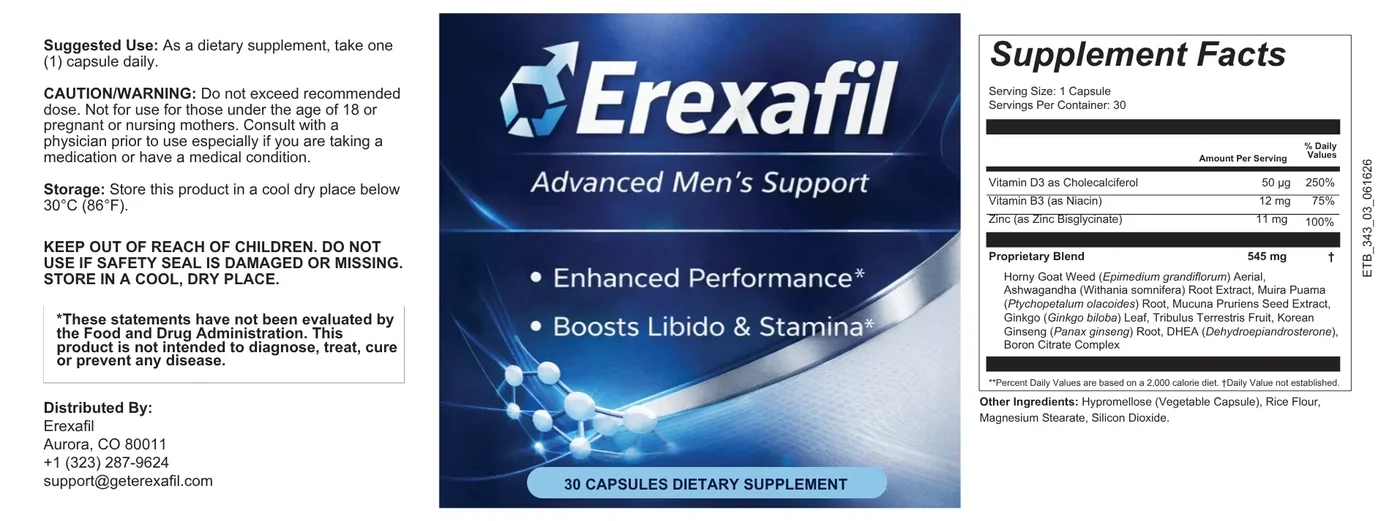
Berberine is not part of the Erexafil formula — Erexafil is a men's vitality capsule built on ginseng, ashwagandha, horny goat weed, zinc and vitamin D3, with every amount printed on the panel. If that is the category you are actually shopping in, the official store has the current options.
Check Availability & PricingDose, timing and the bioavailability problem
Berberine's oral bioavailability is low — a small single-digit percentage of an oral dose reaches systemic circulation, because it is poorly absorbed and heavily processed on the way through. That single fact drives almost every practical decision about how it is taken.
It explains the split dosing. Research protocols have overwhelmingly used roughly 500 mg two or three times a day rather than a single large dose, giving a daily total in the region of 1,000 to 1,500 mg. It explains the timing: doses are taken shortly before or with meals, because the gut-level actions are tied to food arriving. And it explains tolerability, since a single large dose concentrates the digestive side effects that split dosing spreads out.
It also explains the product landscape. Manufacturers have tried to engineer around poor absorption in several ways, and a shopper now faces choices that did not exist a few years ago.
| Form | Typical amount per dose | How it is usually taken | Strength of evidence |
|---|---|---|---|
| Berberine HCl (standard) | 500 mg | Two or three times daily with meals | The form used in most published human research |
| Dihydroberberine | 100–200 mg | Once or twice daily | Better absorbed in pharmacokinetic work; far fewer outcome studies |
| Phytosome / lipid-bound berberine | Product-specific | Once or twice daily | Absorption data exist; long-term outcome data are thin |
| Berberine in a blend | Often undisclosed | As directed on the label | Unverifiable if the amount sits inside a proprietary blend |
| Goldenseal or barberry herb | Variable, low berberine content | Traditional preparations | Not comparable to standardised berberine amounts |
| Cinnamon (comparison) | 1–6 g daily in studies | With meals | Mixed and generally weaker than berberine's data |
| Chromium (comparison) | 200–1,000 mcg daily | Daily | Inconsistent; clearest where intake was inadequate |
Two takeaways from that table. First, if you are comparing products, the meaningful comparison is not "500 mg versus 200 mg" but "which form, at what absorption, with how many published outcomes" — a dihydroberberine capsule at a lower number is not automatically weaker, and a standard capsule at a higher number is not automatically stronger. Second, when the amount is hidden inside a blend, none of this analysis is possible, which is reason enough to skip the product. Anyone searching for the best berberine supplement for blood sugar should treat a disclosed per-capsule milligram figure as the minimum entry requirement.
The most useful question about berberine is not "how many milligrams" but "how much of it ever gets past the gut" — and for a compound whose gut effects may matter as much as its systemic ones, that question does not have one right answer.
What a blood sugar supplement berberine product can and cannot claim
This is where care matters most, so we will be blunt. A blood sugar supplement berberine product is a dietary supplement. Under the rules that govern this category, it may be described as supporting healthy glucose metabolism or supporting normal carbohydrate handling. It may not be described as treating, curing, preventing or reversing diabetes, prediabetes, insulin resistance or any other condition, and any seller who does that is breaking the rules regardless of how good the underlying research looks.
The distinction is not merely legal housekeeping. A person who reads "reverses" and reduces a prescribed medication on that basis can come to real harm quickly. Blood glucose that runs too low is an immediate danger in a way that most supplement problems are not, and it is a specific and foreseeable risk of combining a glucose-lowering supplement with glucose-lowering drugs without supervision. That is why every honest write-up of berberine, including this one, ends up making the same point twice.
Side effects and the interactions that matter
The tolerability profile is dominated by the digestive tract, which follows from where most of the dose stays. Cramping, diarrhoea, constipation, flatulence and nausea are the commonly reported complaints, they are broadly dose-related, and they often improve when the daily amount is split more finely or taken with a larger meal. Berberine is not appropriate during pregnancy or breastfeeding, and it should not be given to infants: berberine can displace bilirubin from albumin, which is a specific and serious concern in newborns.
The interaction profile is the part people underestimate. Berberine inhibits CYP3A4, one of the liver enzymes responsible for metabolising a very large share of prescription medicines, and it inhibits P-glycoprotein, a transporter that moves drugs out of cells. Inhibiting both raises the blood levels of affected drugs, which is the same as taking a higher dose without meaning to. Immunosuppressants, some statins, certain heart-rhythm drugs, some anticoagulants and many others sit in this territory. Add the direct additive effect with glucose-lowering medication and the sedative interaction reported with some central nervous system drugs, and the sensible rule is simple: if you take any prescription at all, ask a pharmacist before starting berberine, not afterwards.
Where berberine fits, and where it does not
Berberine is one of the few supplement ingredients with a mechanism specific enough to be argued about seriously. That is a compliment, and it is also the trap: a compound with a real mechanism attracts claims far beyond what its trials support. The honest framing is that it is a support ingredient for people whose foundations are already in place — meals with adequate protein and fibre, some resistance training, walking after meals, sleep that is not chronically short — and that those foundations move glucose metabolism more than any capsule sold for the purpose.
It is also worth being clear that berberine belongs to a different product category from the one this site mostly covers. It is not in the men's vitality formula we write about; if you want to see what is, the Erexafil ingredient panel lists every nutrient and the botanical blend by name. The two are sometimes stacked by men managing several goals at once, and if you do that, the total capsule load and the interaction question both get more complicated, not less. For a sense of how to read any label critically before stacking anything, our piece on how supplement star ratings get gamed covers the checks we use.
There is one genuine reason a men's health reader ends up on a berberine page, and it is worth naming rather than pretending the overlap does not exist. Insulin resistance and excess visceral fat track with lower testosterone in men, so metabolic health and hormonal health are not separate shelves even though the supplement aisle sells them that way. That does not make berberine a testosterone ingredient — nothing in its trial record supports that claim — but it does mean the foundations matter for both. If it is the hormonal side you actually came for, our guide to how to judge a testosterone booster on studied doses is the more relevant read, and the difference between enhancement pills and testosterone boosters sorts out which category you are even shopping in.
What berberine cannot do
Four limits worth stating without qualification. It cannot treat, cure, prevent or reverse diabetes or any other disease, and it cannot substitute for a prescribed medicine — the comparisons to prescription drugs that circulate online are not a licence to swap one for the other. It cannot be assumed safe alongside prescriptions, because its enzyme and transporter inhibition is broad and real. It cannot be judged by a single blood glucose reading taken at home after a week, because the studies that exist ran for weeks to months and measured longer-term markers. And it cannot be verified at all in a product that hides the amount inside a proprietary blend.
One more limit belongs to us rather than to berberine. This article summarises mechanism, dosing patterns and safety, not any specific commercial product, and we have not tested any. If you are shopping the category and comparing what the best blood sugar supplement options disclose, the panel and the interaction list should decide it — not a ranking, and not a headline.
Medical note: this article is general information, not medical advice. Do not start, stop or change any prescribed medication on the basis of it. Speak to a healthcare professional or pharmacist before taking berberine, particularly if you take any prescription medicine, are pregnant or breastfeeding, or manage a metabolic, liver or heart condition.
Scientific references
- NIH NCCIH — Goldenseal (a berberine-containing herb)
- NIH LiverTox (NCBI Bookshelf) — Berberine
- NIH NCCIH — Diabetes and Dietary Supplements: What the Science Says
- Mayo Clinic — Diabetes treatment: medications and blood sugar
- Guo et al., Oxidative Medicine and Cellular Longevity 2021 — The effect of berberine on metabolic profiles in type 2 diabetic patients: a systematic review and meta-analysis of randomised controlled trials (PubMed)
Frequently asked
How does berberine support blood sugar?
Through several routes at once. Berberine activates AMPK, an enzyme that acts as a cellular energy sensor and shifts cells toward taking up and using glucose. It also slows carbohydrate digestion at the gut wall and changes the composition of the gut microbiome, which affects how much glucose reaches the bloodstream after a meal. Most of this is nutritional support studied in metabolic contexts, and it is not a treatment for any condition.
Why is berberine taken three times a day?
Because absorption is poor and its action is tied to meals. Berberine has low oral bioavailability, so a large single dose does not simply produce a proportionally larger effect, and much of what it does happens in the gut around the time food arrives. Studies have typically split the daily amount into two or three doses taken shortly before or with meals, which also reduces the digestive side effects that a single large dose tends to cause.
What are the side effects of berberine?
Digestive complaints are the common ones: cramping, diarrhoea, constipation, gas and nausea, usually dose-related and often improved by splitting the dose or taking it with food. Berberine is not appropriate during pregnancy or breastfeeding, and it should not be given to newborns. Anyone taking prescribed medication should check with a pharmacist or doctor first, because the interaction profile is the real issue rather than the side effects.
Can berberine replace metformin or other diabetes medication?
No. Berberine is a dietary supplement, not a medicine, and nobody should stop or reduce a prescribed glucose-lowering medication in favour of it. Combining berberine with glucose-lowering drugs can push blood sugar too low, and berberine also inhibits liver enzymes and transporters that many prescriptions depend on, which can raise drug levels. Any use alongside medication needs a conversation with the prescriber first.
Shopping the men's vitality shelf instead?
Erexafil is a once-daily men's support capsule with its nutrient amounts printed on the panel. It contains no berberine — if vitality rather than glucose support is what you are after, the official store lists the current options.
See Erexafil on the Official Store